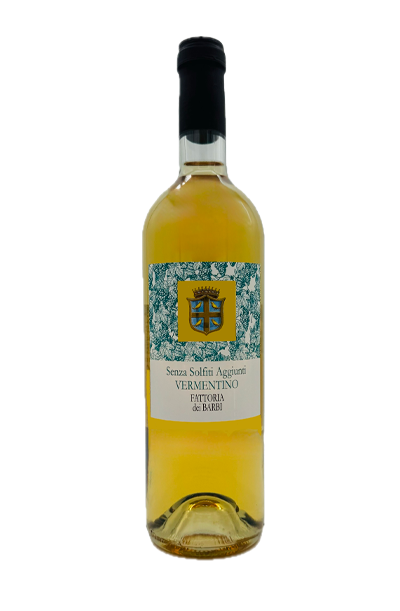
NO SULPHITES ADDED LINE. The wines of the «No Sulfites Added» line come from vineyards in Maremma, where the dry climate is the most suitable for producing healthy grapes essential for making wines without sulfites. The organic grapes are VIVA certified, the protocol of the Ministry of the Environment.
No Sulphites added | BIO | Vermentino IGT Toscana bianco | 2025. This «Senza Solfiti Aggiunti (No Sulphites added)» is made from Vermentino’s grapes 100%. This varietal is vinified with a protocol that excludes any chemical intervention. How is it made? Selected yeasts are used in order to reduce to the minimum also the natural sulfites produced by the fermentation. Maceration with the skins and the fine lees allows to enrich in a natural way, the aromatic richness and stability. The result is an explosion of aromas and scents, a very pleasurable white wine with a long taste.
Grapes Organic Vermentino 100%.
The Year 2025. A mild, rainy winter allowed the soil to build up valuable water reserves, essential in sustaining the vines through the summer months. Spring unfolded in a balanced and regular manner, with well-distributed rainfall encouraging an even and harmonious budbreak. In June, a spell of heat accelerated vegetative growth, yet without inducing significant stress, thanks to the reserves accumulated. By mid-July, conditions shifted to a milder, breezier pattern, guiding the vines toward a slow and steady ripening process. Temperatures remained well-balanced throughout August. September proved decisive. The first half of the month was warm and sun-filled, while the latter brought welcome rainfall along with marked diurnal temperature variation. These significant shifts between day and night enhanced aromatic complexity while preserving remarkable freshness and acidity.
Vinification and Ageing. The grapes were handpicked at perfect maturation. The grapes are destemmed and gently pressed without breaking the skins, encouraging contact between the juice and skins. The skins are then placed into the maceration tank at a constant temperature of 20°C, initiating alcoholic fermentation. The maceration, which is the prolonged contact of the skins with the must, provides protection as an alternative to the addition of SO2, but also allows for the extraction of aromatic compounds and polyphenols, providing to the colour intensity and giving the wine its characteristic golden colour. After approximately 4 days, the wine proceeds to the racking. Alcoholic fermentation continues at 20°C until all sugars are consumed. This is followed by malolactic fermentation, which reduces the wine’s acidity and providing greater roundness. The wine then is left on fine lees for about three months, increasing complexity and improving sensory characteristics with more body, softness, and volume.
Chemical Analysis. Alcohol 12.8% – Tot. Ac. 5.32 g/l – Vol. Ac. 0.36 g/l – Residual sugars 0.14 g/l – pH 3,38 – Malic Acid <0.05 – Free SO2 <2 mg/l – Total SO2 <3 mg/l.
Sensory Analysis. Colour. Deep golden yellow, bright and with notable consistency. Bouquet. Orange peel, citrus notes of grapefruit, dried fruit, floral hints of chamomile, and a pronounced expression of Mediterranean scrub, with marked notes of helichrysum and rosemary. Taste. Savoury and saline, with a long, persistent finish, closing on a distinctive bitter almond note.
Pairings. Not overly elaborate and complex dishes, such as seafood appetizers, baked or boiled fish, octopus, shellfish, ravioli with meat, salty pies, vegetables, and white meats. Perfect as an aperitif and with soft cheeses. Serving Temperature. Serve at a temperature of 8-10°C.
Capacity of Ageing. 2 years.
Conservation and Storage. Keep the bottle horizontally in a dark place at a temperature of 12°-14°C.
Format wine Bordeaux style bottle 0.75 Lt.
Enviromental Labeling