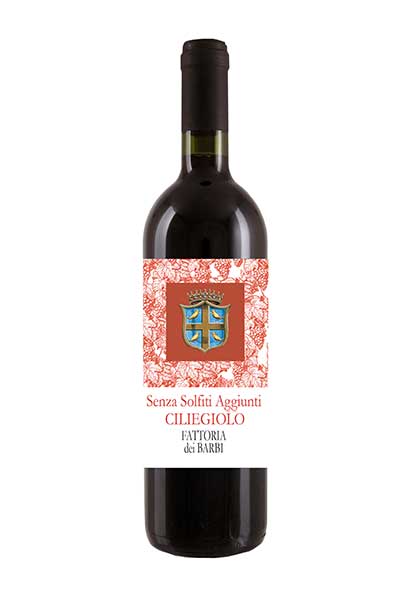
NO SULPHITES ADDED LINE. The wines of the «No Sulfites Added» line come from vineyards in Maremma, where the dry climate is the most suitable for producing healthy grapes essential for making wines without sulfites. The organic grapes are VIVA certified, the protocol of the Ministry of the Environment.
No Sulphites added | Ciliegiolo IGT Toscana rosso | 2025. The Ciliegiolo is part of the Tuscan way of life. A century ago we were among the protagonists of the revival of Sangiovese, so, at Fattoria dei Barbi, we are proud to contribute to the recovery of the Ciliegiolo grape with a version of «Senza Solfiti (No Sulphites added)» made in our way. Our Ciliegiolo is a wine of persuasive aromatic richness, full of primary aromas; its colour is deep red with purple and blood undertones, and it is an easy drinking wine.
Grapes Ciliegiolo 100%.
The Year 2025. A mild, rainy winter allowed the soil to build up valuable water reserves, essential in sustaining the vines through the summer months. Spring unfolded in a balanced and regular manner, with well-distributed rainfall encouraging an even and harmonious budbreak. In June, a spell of heat accelerated vegetative growth, yet without inducing significant stress, thanks to the reserves accumulated. By mid-July, conditions shifted to a milder, breezier pattern, guiding the vines toward a slow and steady ripening process. Temperatures remained well-balanced throughout August. September proved decisive. The first half of the month was warm and sun-filled, while the latter brought welcome rainfall along with marked diurnal temperature variation. These significant shifts between day and night enhanced aromatic complexity while preserving remarkable freshness and acidity
Vinification and Ageing. The grapes were handpicked at perfect maturation. The grapes are destemmed and gently pressed without breaking the skins, encouraging contact between the juice and skins. The grapes are then placed into the maceration tank at a constant temperature of 26°C, initiating alcoholic fermentation. The prolonged maceration allows for the extraction of aromatic notes and polyphenols, which increase the colour intensity and provide protection as an alternative to the addition of SO2. The wine is then separated from the skins. Alcoholic fermentation continues at 26°C until all sugars are consumed. This is followed by malolactic fermentation, which reduces the wine’s acidity and promises greater roundness. The wine is left on fine lees for about three months, increasing complexity and improving sensory characteristics, providing a protective antioxidant function.
Chemical Analysis. Alcohol 11.9% – Tot. Ac. 5.2 g/l – Vol. Ac. 0.31 g/l – Residual sugars < 0.26 g/l – pH 3,33 –Malic Acid <0.08 – Free SO2 <2 mg/l – Total SO2 <3 mg/l.
Sensory Analysis. Colour. Light ruby red with cerasuolo hues, bright and transparent. Bouquet. Maceration enhances the primary aromas of fresh red fruit, with crisp notes of cherry, sour cherry and freshly picked raspberry to the fore, accompanied by delicate floral hints of violet and fresh rose. Taste. Vibrant acidity forms the backbone of the wine, supported by
Pairings. Red meat dishes, cold cuts and aged cheeses. Cacciucco (Tuscan fish stew), seafood salad, fish soup. Serving Temperature. Serve at a temperature of 12°-14°C.
Capacity of Ageing. 2 years.
Conservation and Storage. Keep the bottle horizontally in a dark place at a temperature of 12°-14°C.
Format wine Bordeaux style bottle 0.75 Lt.
Enviromental Labeling